A man before his time -- which means that far too few of the
Powers That Be listened to him.
Here's the introductory paragraph to
his essay, which was published in the California Law Review, Vol. 56, No. 1, January 1968, pp. 74-85:
The experiences resulting from the use of psychedelic drugs are often described in religious terms. They are therefore of interest to those like myself who, in the tradition of William James, are concerned with the psychology of religion. For more than thirty years I have been studying the causes, the consequences, and the conditions of those peculiar states of consciousness in which the individual discovers himself to be one continuous process with God, with the Universe, with the Ground of Being, or whatever name he may use by cultural conditioning or personal preference for the ultimate and eternal reality. We have no satisfactory and definitive name for experiences of this kind. The terms "religious experience," "mystical experience," and "cosmic consciousness" are all too vague and comprehensive to denote that specific mode of consciousness which, to those who have known it, is as real and overwhelming as falling in love. This article describes such states of consciousness induced by psychedelic drugs, although they are virtually indistinguishable from genuine mystical experience. The article then discusses objections to the use of psychedelic drugs that arise mainly from the opposition between mystical values and the traditional religious and secular values of Western society.
The Venerable Alan tells us about his own experience in these realms:
I myself have experimented with five of the principal psychedelics: LSD-25, mescaline, psilocybin, dimethyl-tryptamine (
DMT), and cannabis. I have done so, as William James tried nitrous oxide, to see if they could help me in identifying what might be called the "essential" or "active" ingredients of the mystical experience. For almost all the classical literature on mysticism is vague, not only in describing the experience, but also in showing rational connections between the experience itself and the various traditional methods recommended to induce it: fasting, concentration, breathing exercises, prayers, incantations, and dances. A traditional master of Zen or Yoga, when asked why such-and-such practices lead or predispose one to the mystical experience, always responds, "This is the way my teacher gave it to me. This is the way I found out. If you're seriously interested, try it for yourself." This answer hardly satisfies an impertinent, scientifically minded, and intellectually curious Westerner. It reminds him of archaic medical prescriptions compounding five salamanders, powdered gallows rope, three boiled bats, a scruple of phosphorus, three pinches of henbane, and a dollop of dragon dung dropped when the moon was in Pisces. Maybe it worked, but what was the essential ingredient?
So, we may count the Venerable Alan as a fellow cosmic traveler, and know that he's coming from a trust-worthy place....
[Spontaneous Arising]
download


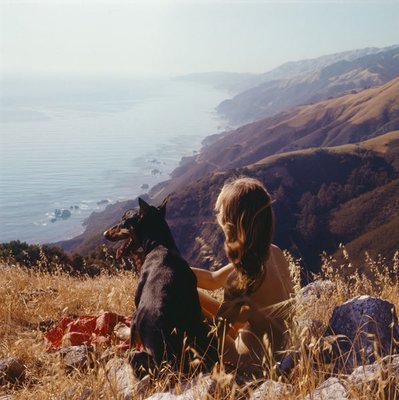 Hunter S. Thompson, Sandy and Agar, Big Sur, California 1961


